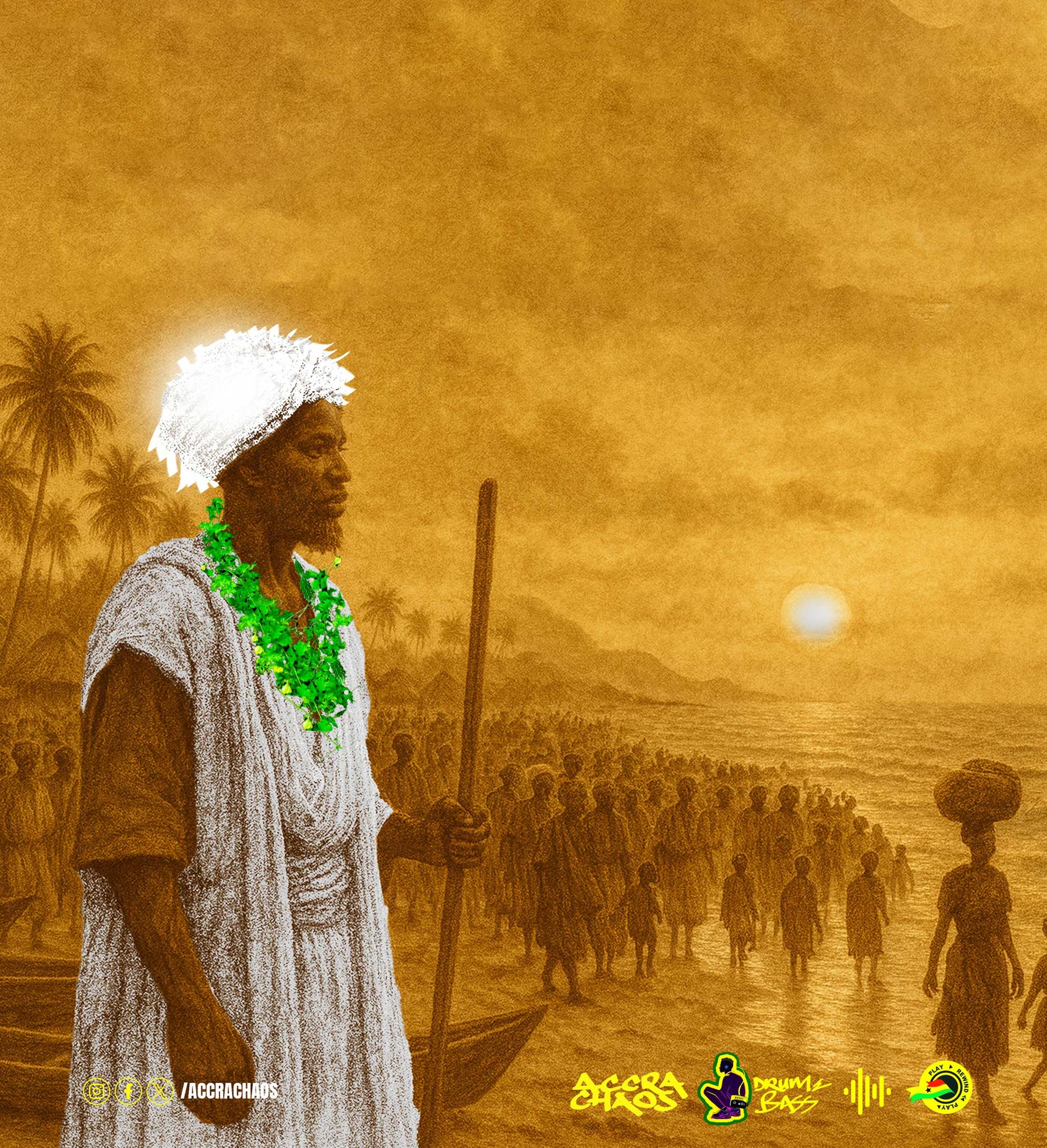
The consolidation of Ga Mashie along the Accra littoral appears, in both oral traditions and subsequent historical interpretation, not as a process of isolationist settlement but as one of negotiated integration with earlier coastal inhabitants, including the Kpeshi. While the precise chronology of interaction remains subject to variation across narrative lineages, the convergence of ethnographic, linguistic, and cultural evidence suggests sustained patterns of contact facilitated through fishing economies, ritual collaboration, and shared access to coastal resources. In such contexts, cooperation was not merely economic but cosmological, as access to fishing grounds and territorial waters required ritual authorization and collective participation. Accordingly, the integration of Ga migrants into the coastal social fabric likely entailed the adaptation and mutual recognition of ceremonial practices that regulated land tenure, shrine authority, and lineage legitimacy.
Within this integrative process, music appears to have functioned as a mediating institution through which social coordination and symbolic affiliation were enacted. Ethnomusicological scholarship on Ga performance traditions identifies instruments such as the gome box drum, the oge friction drum, and kolomashie bells as central to communal ceremonies, fishing expeditions, and ritual observances (Nketia, 1974; Collins, 1994; Collins, 2001; Agawu, 2003). These instruments are not employed arbitrarily; rather, they operate within structured rhythmic systems characterized by interlocking patterns, responsorial vocalization, and hierarchically organized participation. Such musical organization reflects, and arguably reinforces, patterns of social organization, as ensemble performance requires coordination across age grades, lineage groups, and ritual specialists. In this sense, rhythm functions not only as aesthetic expression but as a practical mechanism of collective regulation.
Furthermore, the integration of Ga and Kpeshi communities can be analytically understood through the concept of “acoustic negotiation,” wherein shared musical forms provide a medium for articulating coexistence without necessitating immediate political homogenization. The performance of fishing songs at dawn or invocatory rhythms during ritual observances would have required mutual intelligibility of musical codes, thereby fostering a gradual convergence of expressive forms. As Agawu (2003) and Nketia (1974) caution, African musical systems are embedded in linguistic and social meaning; consequently, the adoption or adaptation of rhythmic structures implies deeper processes of cultural accommodation. Over time, these shared practices likely contributed to the emergence of a distinctly coastal Ga identity—one that retained migratory memory while incorporating local ritual knowledge.
Thus, rather than conceptualizing early Ga–Kpeshi relations as a simple narrative of absorption or dominance, the available evidence supports a more nuanced interpretation of reciprocal adaptation mediated through economic interdependence and ritual performance. Music, in this framework, operated as a form of social diplomacy: it structured cooperation in fishing labor, reinforced spiritual reciprocity, and provided a shared symbolic vocabulary through which migrant and indigenous communities could articulate collective belonging.
Sources: Nketia (1974); Collins (1994, 2001); Agawu (2003).
- Drums of Resilience: Ayawaso, Displacement, and Coastal Reconstitution (c. 1660)
The reported destruction of Ayawaso in the mid-seventeenth century—frequently situated around 1660 and often associated in both oral tradition and historical reconstruction with Akwamu expansion—constitutes a pivotal episode in the political reorganization of Ga society (Parker, 2000; Shumway, 2011). Although the precise sequence of military and migratory events remains subject to historiographical debate, there is broad scholarly agreement that the decline of inland Ayawaso precipitated significant demographic movement toward the coast, thereby accelerating the consolidation of Ga Mashie as a principal locus of authority. Oral traditions preserve this episode not merely as an account of defeat but as a moment of collective testing, in which displacement necessitated institutional adaptation and symbolic reaffirmation of communal identity.
Within this context of political fragmentation and spatial reconfiguration, musical performance appears to have functioned as a mechanism of social stabilization. Ethnographic documentation of Ga ritual practice indicates that polyrhythmic drumming ensembles and responsorial vocal structures were integral to rites of mourning, installation, and communal reaffirmation (Field, 1937; Nketia, 1963). Such performances were not incidental to crisis; rather, they constituted structured responses to it. The interlocking rhythmic patterns characteristic of Ga drumming required coordinated participation across lineage segments, thereby re-enacting social cohesion at a moment when territorial displacement threatened fragmentation. In effect, the disciplined organization of sound mirrored and reinforced the desired reorganization of society.
Moreover, the incorporation of proverbial language into song texts suggests that musical performance operated simultaneously as historical archive and moral commentary. As Yankah (1989) has demonstrated in related Akan contexts, proverbs embedded within performative discourse serve as condensed repositories of social knowledge, capable of articulating critique, instruction, and collective memory without direct confrontation. In Ga musical practice, the strategic deployment of such proverbial forms would have enabled communities to interpret the fall of Ayawaso within a broader cosmological and ethical framework, thereby transforming political trauma into narratively manageable experience. Through repetition and communal participation, these musical texts preserved memory while also re-inscribing legitimacy in the emerging coastal polity.
It is therefore analytically plausible to interpret the post-Ayawaso period as one in which sound functioned not merely as expressive culture but as an instrument of socio-political reconstruction. Drumming and chant structured ritual protection, reaffirmed lineage hierarchies, and facilitated the transition from inland capital to coastal stronghold. The consolidation of Ga Mashie in the aftermath of Ayawaso’s destruction should thus be understood as both a material and symbolic process: material in the relocation and regrouping of populations, and symbolic in the performative reaffirmation of identity through disciplined musical practice. In this sense, music operated as archive, invocation, and proclamation—mediating the transformation of crisis into durable coastal authority.
Sources: Parker (2000); Shumway (2011); Field (1937); Nketia (1963); Yankah (1989).