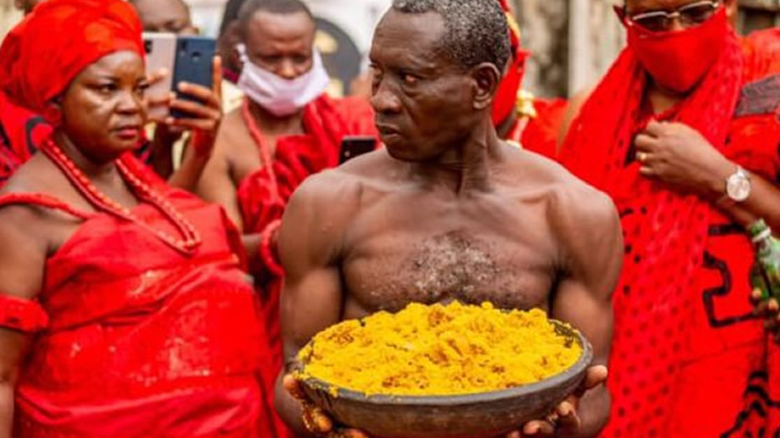
The Homowo festival, whose name is conventionally translated as “hooting at hunger,” occupies a central position within Ga historical consciousness as a ritualized commemoration of famine, displacement, and subsequent recovery. Oral traditions consistently situate the origins of Homowo within a period of severe food scarcity experienced during migratory or early settlement phases, after which agricultural stabilization—particularly the cultivation of maize—enabled collective renewal. While the precise chronology of the famine episode cannot be independently verified in all particulars, ethnographic and historical scholarship affirms the structural role of famine memory in Ga ritual life (Field, 1937; Parker, 2000). Rather than interpreting the festival as a literal reenactment of a single historical event, scholars generally approach it as a commemorative institution through which historical adversity is symbolically managed and transformed into a recurring affirmation of survival.
Ritually, Homowo operates through a sequence of highly codified practices that integrate lineage authority, sacred food symbolism, and musical performance. The preparation and sprinkling of kpokpoi, a ritual maize dish, is conducted under the supervision of designated elders, whose libations invoke ancestral sanction and territorial continuity. These acts do not function merely as festive gestures; they constitute formalized mechanisms for reaffirming lineage legitimacy and spatial claims within Ga Mashie’s quarters, including Usshertown and James Town. In this context, ritual action serves to re-inscribe social hierarchy and intergenerational obligation within a calendrical framework that structures communal time (Field, 1937; Parker, 2000).
Music forms an indispensable component of this ritual complex. Ethnomusicological analysis indicates that Homowo songs employ responsorial structures, layered polyrhythms, and textually dense refrains that encode genealogical references, moral commentary, and collective memory (Nketia, 1974; Collins, 2001). These performances are not improvisational in an unrestricted sense; rather, they are governed by conventions that regulate who may lead, who may respond, and which themes are contextually appropriate. Through repetition across annual cycles, such musical forms function as mnemonic devices, preserving historical narratives and ethical frameworks in performative form. The integration of drum patterns and choral response reinforces participatory cohesion, as communal involvement in song enacts the very solidarity that the festival seeks to commemorate.
Accordingly, Homowo may be analytically understood as a ritual institution that converts historical scarcity into symbolic abundance through structured performance. The annual “hooting” at hunger does not trivialize past suffering; instead, it repositions famine within a moral narrative of endurance, divine or ancestral providence, and agricultural restoration. By embedding famine memory within regulated ceremonial practice, Ga society ensures that collective adversity is neither forgotten nor romanticized, but incorporated into an ongoing process of identity maintenance. Homowo thus functions simultaneously as historical remembrance, socio-political reaffirmation, and aesthetic expression—an institutionalized convergence of oral tradition, ritual authority, and musical continuity.
Sources: Field (1937); Parker (2000); Nketia (1974); Collins (2001).